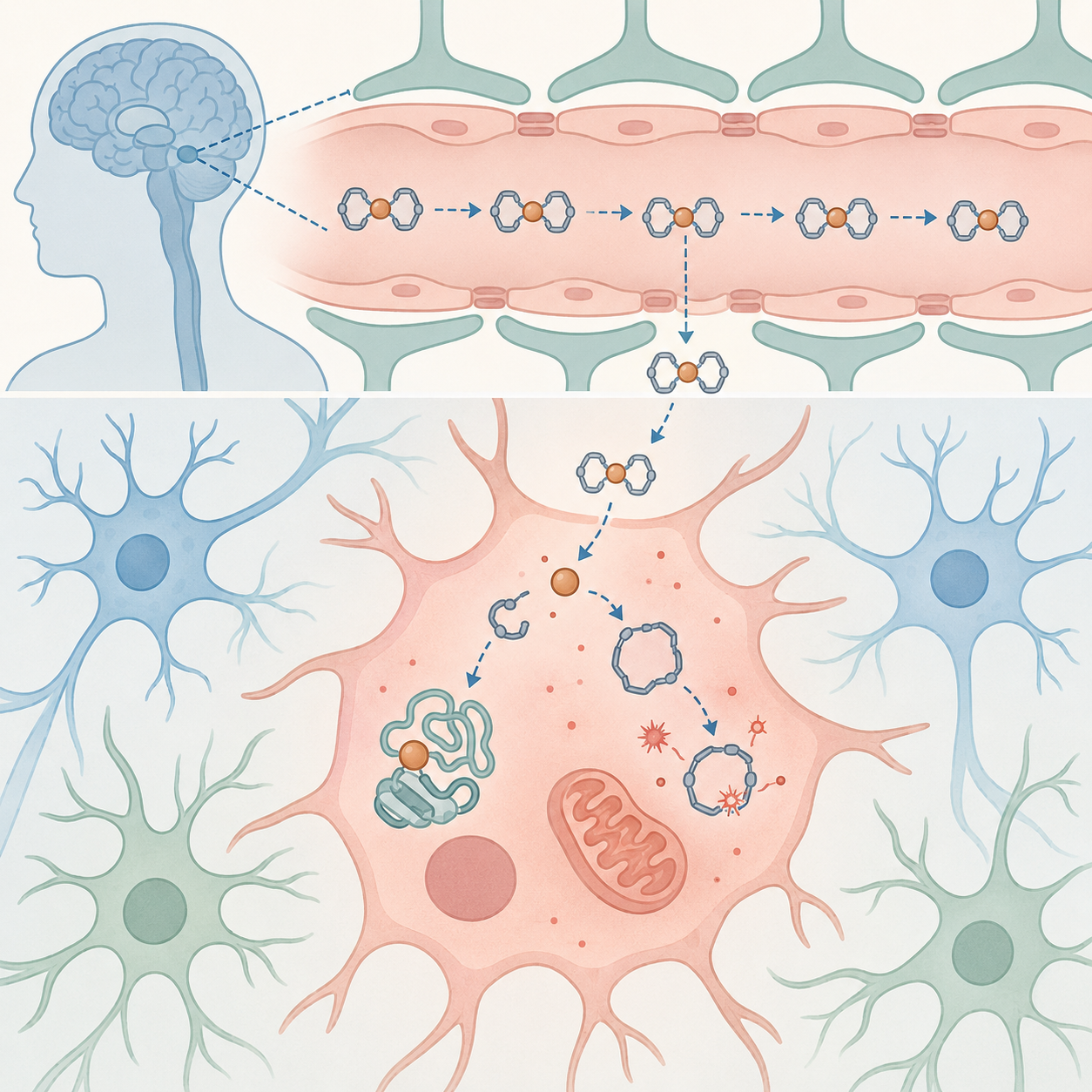
Cu(ATSM) (diacetyl-bis(N⁴-methylthiosemicarbazonato)copper(II)) is a BBB-penetrant, orally bioavailable copper bis(thiosemicarbazone) with an unusually attractive, pleiotropic preclinical profile in neurodegeneration and a conditional "release copper in sick cells" targeting logic. It is one of the more mechanistically interesting investigational compounds in the field. However, the central problem is a widening gap between dramatic preclinical efficacy - derived substantially from a single mutant-SOD1-centered research lineage - and the human data, where the pivotal randomized trial remains unpublished and the only human neuropathological read-out to date showed no significant effect on motor neuron pathology. On current evidence, Cu(ATSM) should be regarded as an investigational agent of considerable biological interest but without controlled clinical proof of benefit in any neurodegenerative condition.
Compound and mechanistic rationale
Cu(ATSM) was originally developed as a hypoxia PET imaging agent. Its therapeutic hypothesis exploits a conditional-release mechanism: the neutral, lipophilic Cu(II) complex crosses the BBB intact and is reduced/dissociated preferentially in cells with a hyper-reductive, mitochondrially compromised intracellular environment, delivering copper selectively to diseased cells rather than systemically. Several distinct mechanisms have been proposed, and their multiplicity is simultaneously a strength (multi-target coverage) and a weakness (mechanistic indeterminacy):
- Copper delivery / SOD1 remetalation. In mutant SOD1 mice, Cu(ATSM) transfers copper to copper-deficient SOD1, increasing enzymatically active holo-SOD1 in the spinal cord - paradoxically raising total mutant SOD1 while improving phenotype - in a CNS-selective fashion with no effect on hepatic SOD1 [1,2]. Overexpression of the copper transporter hCTR1 recapitulates the benefit, and the accumulation of inactive cuproenzymes (SOD1, ceruloplasmin) appears to be a CNS-specific feature of the SOD1 model, both supporting a genuine copper-delivery mechanism in that context [15].
- Anti-ferroptotic activity. Cu(ATSM) inhibits ferroptosis with an EC₅₀ ~130 nM, approaching liproxstatin-1 potency [3]. Critically, Ni(ATSM) shows comparable anti-ferroptotic potency while ionic copper does not, implying the protective effect here is driven by lipid-radical quenching by the bis(thiosemicarbazone) scaffold rather than by copper delivery. This raises a foundational question that the "copper delivery" narrative tends to obscure: in some settings it may be the ligand, not the copper, doing the work.
- Anti-nitrosative stress. Scavenges peroxynitrite, reduces protein nitration/carbonylation, and reduces TDP-43 phosphorylation and fragmentation in spinal cord [4].
- Anti-neuroinflammatory effects. Suppresses microglial/astrocytic activation, lowers TNF-α and MCP-1, and upregulates metallothionein-1 [5,6].
- BBB/amyloid modulation (AD). In APP/PS1 mice, restored P-glycoprotein abundance at the BBB, reduced cortical Aβ42 (~42%), and improved spatial memory (~44%) [7].
Interpretive caution: a molecule credited with four or five independent protective mechanisms across three diseases invites scrutiny. Mechanistic breadth of this kind is frequently a sign that the operative pathway is not yet pinned down, and the ligand-vs-copper ambiguity [3] means even the flagship mechanism is not settled.
Preclinical evidence: strengths and limitations
ALS (mutant SOD1)
The preclinical data are strongest here, with survival extensions reported among the largest for any agent tested in SOD1 mice [2,6]. Three caveats materially limit extrapolation:
- Model dependency. The most dramatic effects are in SOD1-mutant models, which represent ~2% of ALS. The remetalation mechanism is by design tightly coupled to that model, so efficacy may be inflated and poorly generalizable. Demonstration of disrupted copper availability in sporadic human ALS spinal cord (reduced ventral grey-matter copper, impaired ferroxidase activity despite increased ceruloplasmin/hephaestin abundance) provides a rationale for extension beyond SOD1 carriers, but is correlative and does not establish therapeutic benefit [8].
- Dose-dependent, strain-dependent toxicity. In SOD1^G93A mice on a C57BL/6 background, 100 mg/kg/day produced clinical toxicity requiring euthanasia within 3-51 days; efficacy was preserved at 60 mg/kg/day [9]. A therapeutic window that shifts with genetic background is a translational warning sign.
- Concentration of evidence in one lineage. Much of the seminal in vivo work derives from a closely related group of investigators (Melbourne/associated collaborators). This does not invalidate the findings, but independent replication of the magnitude of benefit is comparatively thin, which matters when weighting the discordant human data below.
ALS (sporadic / patient-derived)
In iPSC-derived astrocyte-motor neuron co-cultures, Cu(ATSM) rescued motor neuron survival in only 5 of 7 ALS patient lines, with non-responders spanning both sporadic and familial (C9ORF72, SOD1) subtypes [10]. Response tracked not with mutation but with a distinct mitochondrial metabolic phenotype (elevated basal and ATP-linked respiration), with Cu(ATSM) acting as a "metabolic switch" normalizing that phenotype. This is the most interesting mutation-agnostic signal in the dataset, but it is in vitro only.
Parkinson's disease and Alzheimer's disease
PD rationale rests on copper insufficiency and mitochondrial dysfunction in the PD brain plus neuroprotection in toxin models. AD data are limited to a single APP/PS1 model showing P-gp restoration, Aβ42 reduction, and cognitive improvement [7]. No controlled human efficacy data exist for either indication.
Candidate response-biomarkers (hypothesis-generating only)
Because response is heterogeneous, several stratification strategies have been proposed. None is clinically validated, and the negative human neuropathology below tempers all of them.
- SOD1 mutation status - strongest mechanistic rationale (direct remetalation); ebselen co-therapy has shown synergistic reduction of SOD1 aggregation in vitro [16]. Applies to ~2% of ALS [1,2].
- Elevated astrocyte mitochondrial respiration - the only in vitro predictor of response, mutation-agnostic, potentially assayable by Seahorse-type OCR on patient-derived cells; not yet clinically translatable [10].
- Sporadic ALS with spinal-cord copper dyshomeostasis - mechanistically appealing but detectable only postmortem; no in vivo biomarker exists [8].
- High ⁶⁴Cu-ATSM PET uptake - theranostic concept; imaging validated for detecting oxidative stress, but no study shows uptake predicts therapeutic response [5,14].
Clinical evidence: the critical gap
- Phase 1 (open-label). ALS and PD dose-finding studies reported apparent slowing of progression. These were uncontrolled and open-label. The widely circulated "~70% slowing" figure originated from such a study and from associated media messaging; it is not a controlled efficacy result and should not be treated as one. An internally inconsistent dose signal (lesser-dose patients appearing to do better on some measures) further undercuts a clean interpretation.
- Phase 2/3 (randomized, placebo-controlled; NCT04082832 / CMD-2019-001, ~80 patients, Australia). The trial completed (late 2021) but topline and full results have not been published. In this therapeutic area, a completed controlled trial that is not reported is itself a meaningful (and unfavorable) signal, and independent advocacy scientific-advisory commentary has stated there is currently no substantiated evidence of benefit in humans. The study was also arguably underpowered: ~80 patients would require a large effect to reach significance.
- Human neuropathology - the single most important data point. The first postmortem analysis of trial participants found no significant difference in motor neuron density or TDP-43 burden in motor cortex or spinal cord versus riluzole-only patients; reduced Iba1 (microglial) density was seen, but there was no significant reduction in astrogliosis or SOD1 immunoreactivity [11]. This directly contradicts the robust neuroprotection seen preclinically and is the strongest available evidence against target engagement in the tissue that matters. (Notably, the trial PI is an author, so this is not an adversarial analysis.)
Program status. Development rights sit with Collaborative Medicinal Development / ProCypra Therapeutics; ALS status has remained at an early clinical phase with no active, credible late-stage program in the public record, no regulatory approval, and no positive controlled trial reported.
Safety considerations
- Dose-/strain-dependent toxicity in preclinical models with a background-dependent therapeutic window [9].
- Theoretical cuproptosis risk. Cuproptosis - copper-dependent death via aggregation of lipoylated TCA-cycle proteins and loss of Fe-S cluster proteins - is a mechanistic concern for any agent delivering copper to mitochondria [12,13]. Cu(ATSM) is engineered to release copper precisely in the hyper-reductive mitochondrial environments where cuproptosis is most plausible [5,14]. Whether therapeutic dosing restores homeostasis or risks localized overload is unresolved; copper-related biomarker monitoring is prudent in any future trial.
- Human short-term tolerability at studied doses has generally been acceptable, but this is the only domain where human data are reassuring.
Theranostic dimension
⁶⁴Cu-ATSM is an established PET tracer for oxidative stress, with elevated uptake reported in disease-relevant regions in PD, early AD (correlating with amyloid PET burden), and ALS [5,14,17,18]. The theranostic appeal - same molecule for imaging and therapy - carries an intrinsic tension: the redox-dependent retention that makes it a good tracer (trapping in diseased tissue) is not the same as achieving sufficient, sustained, therapeutically active tissue concentrations, and the two need not co-vary.
Synthesis and appraisal
Cu(ATSM) has favorable drug-like properties (oral, BBB-penetrant), a genuinely clever conditional-delivery concept, and compelling preclinical data - but the evidentiary structure is fragile in three specific ways. First, the flagship mechanism is contested: the ligand alone reproduces key protection (anti-ferroptosis), so "copper delivery" may be an incomplete or partly incorrect account [3]. Second, the strongest efficacy data are concentrated in a SOD1 model that represents a small minority of patients and in work from a narrow investigator base, while independent human read-outs are discordant. Third - and decisively for now - the pivotal randomized trial is unpublished and the first human neuropathology showed no neuroprotective effect [11]. Taken together, the compound is better understood at present as an instructive case of preclinical-to-clinical translation failure than as a near-term therapeutic.
If a real effect exists, the in vitro heterogeneity data suggest it may be confined to a metabolically defined subpopulation [10], which would make biomarker-driven enrichment essential to any future trial. Concretely, the developments that would move this from "interesting biology" to "credible therapy" are: (1) publication of the completed Phase 2/3 dataset with prespecified endpoints; (2) prospective validation of a mitochondrial-respiration or ⁶⁴Cu-ATSM-PET enrichment biomarker; and (3) clean resolution of the copper-vs-ligand mechanism, since it dictates both efficacy expectations and the cuproptosis safety calculus.
Evidence-domain summary
Domain | Strength | Principal limitation | Refs |
|---|---|---|---|
Mechanism | Pleiotropic (ferroptosis, peroxynitrite, copper delivery, neuroinflammation) | Copper-vs-ligand ambiguity; Ni(ATSM) mimics anti-ferroptosis | 1-4 |
Preclinical ALS (SOD1) | Among longest survival extensions in SOD1 mice | SOD1 ≈ 2% of ALS; dose-/strain-dependent toxicity; single lineage | 2,6,9 |
Preclinical ALS (sporadic) | Neuroprotection in toxin model; human copper dyshomeostasis shown | Few models; 5/7 in vitro response heterogeneity | 8,10 |
Preclinical AD | ↓Aβ42, restored P-gp, improved cognition (APP/PS1) | Single model; no human data | 7 |
Clinical ALS | Phase 2/3 completed; open-label hints of benefit | Pivotal results unpublished; postmortem shows no neuropathological benefit | 8,11 |
Safety | Oral, BBB-penetrant; acceptable short-term human tolerability | Dose-dependent toxicity; theoretical cuproptosis risk | 9,12-14 |
Theranostic | ⁶⁴Cu-ATSM PET validated for oxidative stress | Tracer retention ≠ therapeutic exposure; response prediction unproven | 5,14,17,18 |
References
- Roberts BR, et al. Oral treatment with Cu^II^(atsm) increases mutant SOD1 in vivo but protects motor neurons and improves the phenotype of a transgenic mouse model of ALS. J Neurosci. 2014.
- Hilton JB, et al. Cu(atsm) improves the neurological phenotype and survival of SOD1 mice and selectively increases enzymatically active SOD1 in the spinal cord. Sci Rep. 2017.
- Southon A, et al. Cu(atsm) inhibits ferroptosis: implications for treatment of neurodegenerative disease. Br J Pharmacol. 2020.
- Soon CPW, et al. Cu^II^(atsm) protects against peroxynitrite-induced nitrosative damage and prolongs survival in an ALS mouse model. J Biol Chem. 2011.
- Lin W, et al. Cu^II^-bis(thioureido) complex: a potential radiotracer for detecting oxidative stress and neuroinflammation in neurodegenerative diseases. Semin Nucl Med. 2025 (review).
- Kuo MTH, Beckman JS, Shaw CA. Neuroprotective effect of CuATSM on neurotoxin-induced motor neuron loss in an ALS mouse model. Neurobiol Dis. 2019.
- Pyun J, et al. Cu(ATSM) restores BBB abundance of P-glycoprotein and improves cognitive function in the APP/PS1 mouse model of AD. ACS Chem Neurosci. 2026.
- Hilton JBW, et al. Evidence for disrupted copper availability in human spinal cord supports Cu^II^(atsm) as a treatment option for sporadic cases of ALS. Sci Rep. 2024.
- Lum JS, et al. CuATSM improves motor function and extends survival but is not tolerated at a high dose in SOD1^G93A^ mice with a C57BL/6 background. Sci Rep. 2021.
- Dennys CN, et al. CuATSM effectively ameliorates ALS patient astrocyte-mediated motor neuron toxicity in human in vitro models of ALS. Glia. 2023.
- Yang Y, Rowe D, McCann H, et al. Treatment with the copper compound CuATSM has no significant effect on motor neuronal pathology in patients with ALS. Neuropathol Appl Neurobiol. 2023.
- Liu S, et al. Copper and cuproptosis: from homeostasis to pathogenesis. Chem Biol Interact. 2026 (review).
- Chen L, Min J, Wang F. Copper homeostasis and cuproptosis in health and disease. Signal Transduct Target Ther. 2022 (review).
- Ikawa M, et al. PET imaging for oxidative stress in neurodegenerative disorders associated with mitochondrial dysfunction. Antioxidants. 2020 (review).
- Hilton JB, Kysenius K, White AR, Crouch PJ. The accumulation of enzymatically inactive cuproenzymes is a CNS-specific phenomenon of the SOD1 mouse model of ALS and can be restored by overexpressing hCTR1. Exp Neurol.