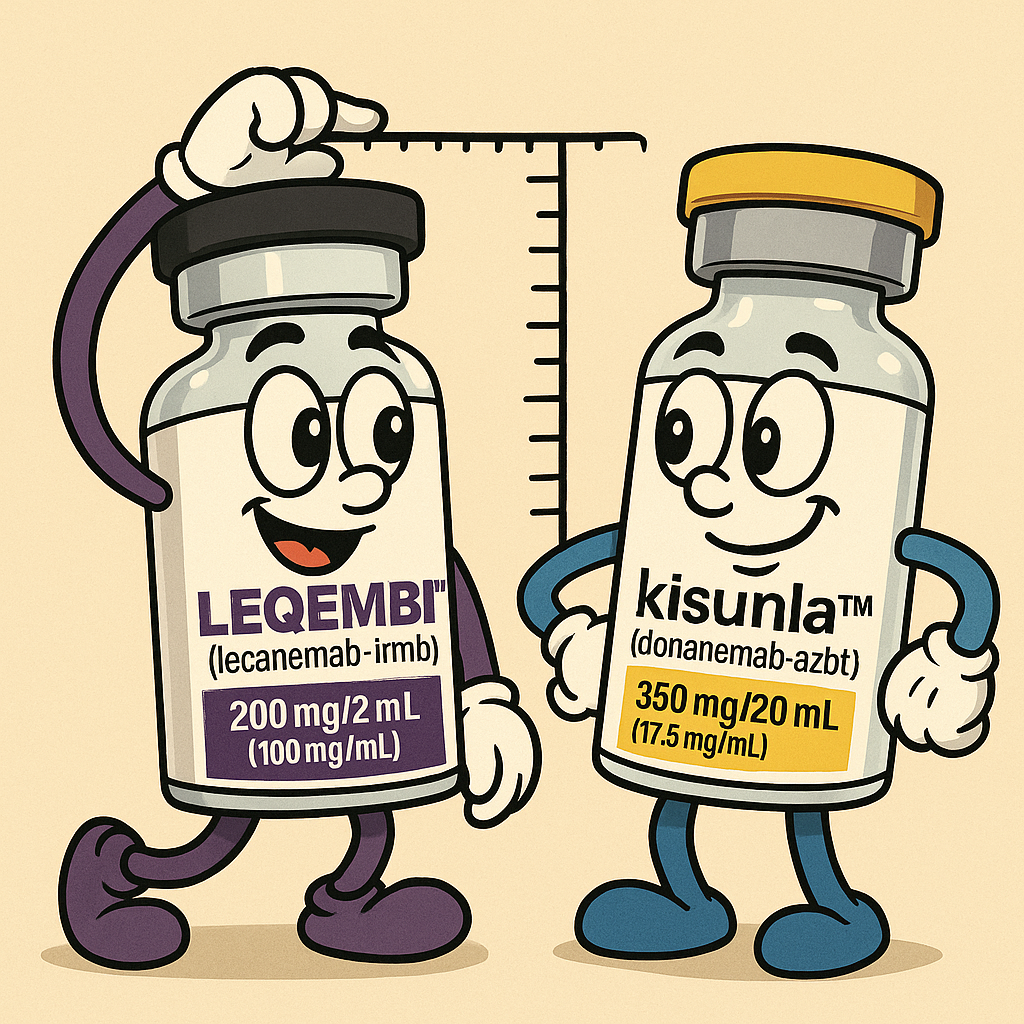
Alzheimer's disease (AD) has long challenged the boundaries of medicine, given its slow, degenerative course and the limited efficacy of symptomatic treatments. However, the recent FDA approvals of two monoclonal antibodies - Lecanemab (Leqembi) and Donanemab (Kisunla) - mark a shift toward disease-modifying approaches. These agents target amyloid-beta (Aβ), a hallmark pathology in AD, but they differ in molecular target, trial design, efficacy profiles, and risk profiles.
Mechanisms of Action and Targets
- Lecanemab binds to soluble Aβ protofibrils, targeting early toxic species before plaques form. These protofibrils are believed to drive early neurotoxicity.
- Donanemab binds to a pyroglutamate Aβ epitope, present only in deposited amyloid plaques, directly engaging established pathology.
Head-to-Head Comparison Table
Metric | Lecanemab (Leqembi) | Donanemab (Kisunla) |
|---|---|---|
Mechanism | Targets soluble Aβ protofibrils | Targets deposited plaques (N-terminal pyroglutamate Aβ) |
Manufacturer | Eisai (lead), co-promoted with Biogen | Eli Lilly |
FDA Approval Date | July 6, 2023 | July 2, 2024 |
Trial Basis | Phase 2 and Phase 3 (Clarity AD) | Phase 2 and Phase 3 (TRAILBLAZER-ALZ 2) |
Trial Duration | 18 months | 76 weeks (18 months) |
Participants | ~1,800 | 1,736 |
Primary Endpoint | CDR-SB (0-18 scale) | iADRS (0-144 scale) |
Efficacy (CDR-SB) | 0.45-point improvement (27% slowing) | 0.67-point improvement (36% slowing in low/medium tau); 0.70-point / 28.9% slowing overall |
Efficacy (iADRS) | Not a primary endpoint | 3.25-point difference (35.1% slowing in low/medium tau); 2.92-point / 22.3% slowing overall |
Amyloid Reduction | -59.1 Centiloids | -88 Centiloids |
Dosing Schedule | IV infusion every 2 weeks | IV infusion every 4 weeks (stopped after plaque clearance) |
ARIA-E (Brain Swelling) | 12.6% overall; 2.8% symptomatic | 24.0% overall; 6.1% symptomatic |
ARIA-H (Microhemorrhage) | Severe bleeding in 5 cases | Severe bleeding in 7 cases; 3 fatal cases |
Infusion Reactions | 26.4% | 8.7% |
Deaths in Trial | 5 treatment-related bleeding events | 3 treatment-related deaths |
Plasma Biomarkers | No clear tau lowering shown | Reduced plasma P-tau217 |
MRI Volume Changes | Data not highlighted | Accelerated brain atrophy noted (decreased brain volume, increased ventricles) |
Eligibility | MCI or mild dementia due to AD with confirmed amyloid | Same, with additional tau stratification by PET |
Exclusion Criteria | >4 microhemorrhages, superficial siderosis, seizures, etc. | Same + extensive tau burden, severe white matter disease |
Cost Estimate | ~$5,300/year (Medicare co-insurance) | ~$6,400/year (Medicare co-insurance) |
Clinical Interpretation and Considerations
While both lecanemab and donanemab demonstrated statistically significant effects in reducing amyloid plaque burden and slowing clinical progression in early-stage Alzheimer's disease, the clinical significance of these findings remains a subject of active discussion within the neurology community.
1. Modest Effect Sizes vs. Meaningful Change
The minimal clinically important difference (MCID) for both the Clinical Dementia Rating-Sum of Boxes (CDR-SB) and the Integrated Alzheimer's Disease Rating Scale (iADRS) exceeds the average treatment-placebo differences reported in the pivotal trials:
For CDR-SB, the MCID is generally estimated at 1.0 points for mild cognitive impairment (MCI) and 1.6 points for mild dementia. Lecanemab's treatment effect in the Clarity AD trial yielded a 0.45-point difference, and donanemab's effect in TRAILBLAZER-ALZ 2 was 0.67 points in the low/medium tau group—both below thresholds typically considered perceptible to patients or caregivers.
Similarly, iADRS changes of 3.25 points (donanemab) also fall below the MCID of 5 to 9 points, depending on disease severity.
Thus, while percentage slowing (e.g., 27% or 36%) appears favorable, absolute cognitive gains remain modest. These effects may be more meaningful when compounded over time or used in conjunction with other interventions, but on their own, they may not translate to a noticeable change in day-to-day functioning for many patients.
2. Real-World Applicability and Safety Caveats
The safety profile of both agents—particularly regarding amyloid-related imaging abnormalities (ARIA) and brain atrophy—necessitates caution when translating these therapies to general clinical practice:
In trials, MRI monitoring was intensive, with prespecified imaging intervals and rapid management of ARIA events. In real-world settings, this level of surveillance may not be consistently feasible, particularly in resource-limited or rural clinics.
Rates of ARIA-E and ARIA-H were significantly higher in ApoE ε4 carriers, especially homozygotes, underscoring the importance of genetic testing prior to initiation. Yet in clinical settings, access to ApoE genotyping and neurologist-led oversight may be variable.
Accelerated brain atrophy, including decreased total brain volume and increased ventricular size, was observed in donanemab-treated patients. While amyloid removal may unmask underlying neurodegeneration, the phenomenon raises concerns about net neuroanatomical impact of these therapies, especially over longer durations.
In this context, the number needed to harm (NNH) has been estimated at approximately 3, meaning for every three patients treated, one may experience a serious adverse effect, including ARIA-related bleeding or edema. This must be weighed carefully against the potential—but modest—clinical benefit.
3. Role of Biomarkers and Tau Stratification
Patient selection is key to maximizing benefit and minimizing harm:
Donanemab trials incorporated tau PET imaging to stratify participants by disease stage. Results suggested greater benefit in those with low-to-moderate tau burden, likely representing an earlier, more modifiable disease stage. This stratified approach supports more precision-based prescribing, though tau PET remains costly and less accessible than amyloid PET or CSF analysis.
In contrast, lecanemab showed consistent efficacy across a more generalized early AD cohort, suggesting broader applicability without the need for tau staging. This may make lecanemab more clinically feasible in diverse practice settings where tau PET is unavailable.
4. Caution in Interpreting Comparative Efficacy (27% vs. 32-36%)
While public and professional discussions often cite that lecanemab slowed clinical decline by 27% and donanemab by 32-36%, this apparent difference does not represent a true head-to-head comparison and should be interpreted with caution.
- The 27% figure for lecanemab comes from the Clarity AD trial, which used the Clinical Dementia Rating-Sum of Boxes (CDR-SB) as its primary endpoint across a broad early Alzheimer's population (mild cognitive impairment or mild dementia due to AD) with amyloid confirmation via PET or CSF.
- The 35-36% figure for donanemab comes from a subgroup analysis of the TRAILBLAZER-ALZ 2 trial, focusing on participants with low/medium tau pathology as determined by tau PET. This represents a more narrowly defined, earlier-stage cohort, excluding individuals with higher tau burden—a criterion not applied in the lecanemab trial.
Importantly, the overall efficacy of donanemab across the full population—including those with both low/medium and high tau levels—was:
- 28.9% slowing on CDR-SB
- 22.3% slowing on iADRS
This means that the true CDR-SB-based average slowing across all donanemab-treated participants was 28.9%, which is comparable to lecanemab's 27%, and that the oft-cited 22% figure applies to iADRS, not CDR-SB.
Key Points for Interpretation:
CDR-SB and iADRS are different instruments, each with distinct ranges, sensitivities, and minimal clinically important differences (MCIDs). Presenting percentage slowing without specifying the underlying scale can create a misleading sense of comparative superiority.
The effect sizes for both therapies are modest in absolute terms, and well below the MCID for either instrument in most cases.
These percentages reflect group-level trends, not the likely clinical experience of any individual patient. They do not account for heterogeneity in patient trajectory, risk tolerance, or comorbidities.
Bottom Line:
The difference between 27% and 28.9% or even 35% in selected subgroups is not clinically decisive. More importantly, these results:
- Reflect trials with different designs, biomarkers, and outcome measures
- Represent average deltas, not guaranteed outcomes
- Should not be interpreted as clear evidence of one agent's superiority
Until direct comparative trials or individual patient-level meta-analyses are available, decisions between these therapies should be made based on:
- Patient eligibility and biomarker profile
- ARIA risk and ApoE genotype
- MRI access and clinical monitoring infrastructure
- Patient and caregiver goals of care
In sum, percent slowing alone is not a sufficient basis for choosing between agents. Careful contextualization is essential.
Conclusion
Lecanemab and donanemab represent a promising new class of anti-amyloid immunotherapies, marking the beginning of disease-modifying treatment in Alzheimer's care. Despite a shared class effect, their pharmacologic targets, administration schedules, treatment algorithms, and risk-benefit profiles differ meaningfully.
- Lecanemab offers a predictable, biweekly regimen that targets protofibrils, potentially offering earlier intervention but requiring longer cumulative exposure.
- Donanemab aims for aggressive plaque clearance, with the possibility of treatment discontinuation, and demonstrates greater relative efficacy in biomarker-selected subgroups, but at the cost of more pronounced brain volume loss and a higher ARIA burden.
Ultimately, both agents require:
- Rigorous patient screening, including biomarker confirmation of amyloid pathology.
- Baseline and serial MRI surveillance for ARIA.
- Genetic counseling and ApoE genotyping, when available.
- Close neurologic oversight, ideally within multidisciplinary memory clinics or centers equipped for high-touch monitoring.
Their use should be guided not solely by FDA approval but by individualized assessment of risk, benefit, access to monitoring infrastructure, and patient/family goals of care. As more data emerge from long-term open-label extensions and real-world cohorts, clinicians will be better positioned to refine use of these agents in practice.
References
Key Publications on Lecanemab
- van Dyck, C. H., Swanson, C. J., Aisen, P., Bateman, R. J., Chen, C., Gee, M., Kanekiyo, M., Li, D., Reyderman, L., Cohen, S., Froelich, L., Katayama, S., Sabbagh, M., Vellas, B., Watson, D., Dhadda, S., Irizarry, M., Kramer, L. D., & Iwatsubo, T. (2023). Lecanemab in early Alzheimer's disease. New England Journal of Medicine, 388(1), 9-21. https://doi.org/10.1056/NEJMoa2212948
- Cohen, S., van Dyck, C. H., Gee, M., Doherty, T., Kanekiyo, M., Dhadda, S., Li, D., Hersch, S., Irizarry, M., & Kramer, L. D. (2023). Lecanemab Clarity AD: Quality-of-life results from a randomized, double-blind phase 3 trial in early Alzheimer's disease. Journal of Prevention of Alzheimer's Disease, 10(4), 771-777. https://doi.org/10.14283/jpad.2023.123
- Swanson, C. J., Zhang, Y., Dhadda, S., Wang, J