Introduction
The startle reflex and its associated defensive motor circuits represent one of the most conserved elements of the vertebrate nervous system. Across taxa, from lampreys to humans, the ability to abruptly interrupt behavior, stiffen the body, and prepare for escape or confrontation is preserved in form and function. These circuits do not generate new voluntary action; instead, they operate as a global interrupt signal, locking musculature in transient isometric co-contraction and thereby freezing the organism in time and space. This neural architecture has deep evolutionary roots, and its clinical echoes in humans — hyperekplexia, startle epilepsy, pathological posturing — remind us that the oldest reflexes of the brainstem still govern life and death responses.
Comparative Evolutionary Anatomy
Primitive Origins in Early Vertebrates
The story of the startle and defensive circuits begins with the earliest vertebrates: jawless fishes such as hagfish and lampreys, which diverged more than 500 million years ago. Even in these basal species, the blueprint of the vertebrate motor hierarchy is already visible — a hindbrain containing large reticulospinal command neurons projecting directly to spinal cord interneurons and motoneurons.
Lampreys and the Reticulospinal Archetype
Lampreys provide the clearest window into this ancestral design. Their hindbrain houses a set of large, individually identifiable reticulospinal neurons, often called Müller cells. Each Müller cell extends a giant axon down the length of the spinal cord, forming monosynaptic or disynaptic connections with motoneurons and with excitatory and inhibitory interneurons. This arrangement allows a single reticulospinal neuron to initiate coordinated locomotor patterns across multiple body segments.
The significance of this cannot be overstated: the first vertebrate brainstem was already built as a command center. Rather than producing complex voluntary actions, its job was to issue all-or-none motor commands — sudden swimming bursts to escape predators, or whole-body stiffening to brace against environmental perturbations. In lampreys, the reticulospinal neurons act as the master switches of motor behavior, a theme that recurs throughout vertebrate evolution.
Hagfish as a Contrast
Hagfish, another lineage of jawless fish, show a reduced degree of reticulospinal specialization compared to lampreys. Their motor responses are slower and less sharply patterned, reflecting their benthic scavenger lifestyle. The relative impoverishment of their reticulospinal system highlights how strongly ecological niche shapes the retention or elaboration of these primitive circuits. The lamprey’s reliance on rapid swimming escape demanded a rich array of giant RS neurons, whereas the hagfish’s slow, burrowing behavior did not.
The Vestibular Contribution Emerges
Alongside the reticulospinal tracts, early vertebrates also developed the vestibular apparatus, likely evolving from mechanosensory hair cell organs of pre-vertebrate chordates. In lampreys, the vestibular end organs are simple but already project into distinct vestibular nuclei within the hindbrain. From these nuclei, descending vestibulospinal fibers project to spinal interneurons and motoneurons, especially those controlling axial muscles.
This addition was crucial: whereas the reticulospinal system provided command initiation (e.g., start swimming), the vestibulospinal system provided postural tone and stability, anchoring the organism against gravity or sudden perturbations. In this dual architecture — reticulospinal for global interrupts and vestibulospinal for stabilization — the fundamental defensive motor scaffold of vertebrates was set.
Evolutionary Implications
The presence of giant reticulospinal neurons in lampreys establishes a continuity with later vertebrate structures such as the Mauthner cell in teleost fish and the giant neurons of the pontine reticular formation in mammals. The vestibulospinal system, rudimentary in jawless fish but rapidly elaborated in amphibians and beyond, ensured that defensive reflexes combined both movement initiation and postural bracing.
Thus, by the time jawless vertebrates had emerged, the core circuitry of startle and freezing was already in place:
Large reticulospinal command neurons capable of issuing whole-body interrupt signals.
Early vestibular projections stabilizing posture and bracing against environmental challenges.
What evolution added later — from Mauthner cells in teleosts to the pontine reticular nuclei in mammals — were variations on this primitive theme, not new inventions.
Mauthner Cells and the Teleost Escape Reflex
Among vertebrates, no system better illustrates the logic of the startle circuit than the Mauthner cell of teleost fishes. First described by Ludwig Mauthner in the late 19th century, this neuron is among the best-characterized single cells in all of vertebrate neurobiology and serves as the archetype of the vertebrate “command neuron.”
Anatomical Features
Location: Each Mauthner cell lies in the rhombomere 4 region of the hindbrain, one per side.
Morphology: These neurons are enormous—among the largest vertebrate neurons—featuring a massive soma (~100 μm in diameter), a thick axon (>20 μm), and two major dendrites:
Lateral dendrite: receives auditory and mechanosensory input, primarily from the VIIIth cranial nerve.
Medial dendrite: receives vestibular, visual, and other sensory inputs.
Axonal projection: Each axon crosses the midline and descends caudally in the contralateral spinal cord, giving off collaterals at each segment. It forms monosynaptic excitatory connections with contralateral motoneurons and inhibitory interneurons that suppress ipsilateral motoneurons (Zottoli, 1977).
Physiological Properties
The defining feature of the Mauthner system is its all-or-none activation:
A single action potential in the Mauthner cell reliably produces the C-start escape response, a rapid unilateral contraction that bends the body away from a stimulus (Faber & Korn, 1978).
The latency of response is exceptionally short (~5–10 ms), reflecting the directness and giant size of the axon and its synapses.
The neuron integrates multiple sensory modalities (auditory, vestibular, tactile, visual) but is especially sensitive to acoustic/vibratory cues—making it a true homolog of the acoustic startle pathway in higher vertebrates (Korn & Faber, 2005).
The C-Start Escape Response
The C-start consists of two stages:
Stage 1: The fish bends its body into a C-shape away from the stimulus, driven by unilateral contraction of trunk musculature.
Stage 2: A propulsive stroke of the tail propels the fish forward, away from the threat.
This entire behavior is initiated by a single spike in the Mauthner cell and completed within tens of milliseconds—fast enough to evade many aquatic predators.
Circuit Organization
Excitation: The Mauthner cell excites contralateral spinal motoneurons directly and via excitatory interneurons.
Inhibition: At the same time, it activates glycinergic inhibitory interneurons that silence ipsilateral motoneurons, ensuring asymmetric contraction (Faber & Korn, 1978).
Feedforward inhibition: A rapid inhibitory feedback system (via recurrent inhibitory interneurons) ensures that only one Mauthner cell fires per escape event, preventing simultaneous bilateral contraction.
Evolutionary and Comparative Significance
The Mauthner cell is present in most teleost fishes and many amphibians but absent in mammals, which instead rely on populations of smaller reticulospinal neurons (Foreman & Eaton, 1993).
Teleosts do not rely solely on the Mauthner cell; they possess a reticulospinal array of ~500 neurons capable of initiating escape responses. Nevertheless, the Mauthner cell is the most reliable and fastest of these, serving as the “last line of defense.”
This organization illustrates the broader evolutionary principle: giant, fast neurons dedicated to emergency interrupts. In higher vertebrates, this logic persists in the giant neurons of the caudal pontine reticular nucleus (PnC), albeit distributed across a population rather than a single identifiable cell.
Amphibians and Early Tetrapods
The amphibians — frogs, toads, and salamanders — mark a critical evolutionary stage in the development of startle and defensive circuits. By this point, vertebrates had transitioned from purely axial locomotion (lamprey undulation, fish swimming) to limb-based movement. This shift required significant reorganization of descending brainstem systems.
Reticulospinal System in Amphibians
In frogs (Rana spp.), the hindbrain retains a dense population of reticulospinal (RS) neurons that extend into the cervical and lumbar spinal cord. Shapovalov’s comparative electrophysiological work (1972) demonstrated that amphibian RS neurons make monosynaptic excitatory connections with limb motoneurons, in contrast to fish where the emphasis is axial musculature【Shapovalov, 1972; cited in Grillner & Dubuc, 1988】.
Organization: RS neurons in amphibians are distributed in the pontine and medullary reticular formation. Some are morphologically large, resembling smaller-scale versions of Mauthner homologs.
Function: These neurons can evoke coordinated flexion or extension of the limbs, providing the neural substrate for sudden whole-body withdrawal responses (e.g., jumping, crouching, or stiffening when startled).
Vestibulospinal System Emergence
The amphibians are the earliest vertebrates where a distinct lateral vestibulospinal tract (LVST) is identifiable.
Origin: The LVST arises from the lateral vestibular nucleus (Deiters’ nucleus) in the medulla.
Projection: It descends ipsilaterally through the ventral funiculus to innervate interneurons and extensor motoneurons across multiple spinal segments.
Function: Provides tonic activation of limb extensors, critical for postural support on land (where gravity exerts stronger demands than in water).
Additionally, the medial vestibulospinal tract (MVST) begins to appear in amphibians, projecting bilaterally to cervical spinal levels, coordinating head–neck stabilization and gaze reflexes. This represents a critical step toward terrestrial balance and defensive bracing.
Tonic Reflexes in Amphibians
Amphibians express “tonic reflexes” mediated by these tracts. For instance, when the head is tilted, vestibulospinal pathways trigger compensatory limb and trunk adjustments, a forerunner of the tonic neck reflexes observed in higher vertebrates (Eccles et al., 1975). These reflexes not only stabilize posture but also serve defensive roles — freezing the animal in crouched, stiffened positions when threatened.
Integration with Startle
Startle responses in frogs are multimodal:
Acoustic startle: auditory input relayed through the torus semicircularis (midbrain auditory center) and then into reticulospinal neurons.
Tactile startle: skin mechanoreceptor input via trigeminal relays into the brainstem.
Vestibular startle: sudden motion of the head activates vestibular nuclei, whose vestibulospinal outputs synergize with reticulospinal bursts to stiffen the body.
Thus, amphibians demonstrate the first integration of reticulospinal and vestibulospinal systems into a coordinated freezing/defensive posture that is limb-based, not solely axial.
Reptiles and Birds
In reptiles, the reticulospinal tracts are well developed and contribute to locomotor initiation as well as startle-like whole-body stiffening. Birds, with their unique balance and flight requirements, evolved expanded vestibular nuclei but retained the same organizational plan: reticulospinal bursts for global interrupts, vestibulospinal outputs for extensor tone and postural stability. The freezing reflex in birds is readily elicited by sudden acoustic or visual stimuli, demonstrating the persistence of this conserved plan.
Mammals: Pontine Reticular Nuclei and the Human Startle
In mammals, the startle reflex has been anatomically and physiologically localized to the caudal pontine reticular formation (PnC), specifically a population of giant glutamatergic neurons situated in the nucleus reticularis pontis caudalis (also called the caudal pontine reticular nucleus, or RPC). These neurons are the mammalian counterparts, in function if not in morphology, to the giant reticulospinal neurons of lower vertebrates such as the Mauthner cells of fish.
Anatomical Substrate
Localization: The critical generator neurons lie ventromedially in the caudal pons, near the facial nucleus. Studies in rodents using lesions, pharmacological inactivation, and electrophysiology have repeatedly confirmed this localization (Koch & Schnitzler, 1997; Yeomans & Frankland, 1996).
Inputs: Sensory information from the auditory nerve reaches the cochlear root neurons, which provide the first obligatory relay into the startle circuit. From there, fast excitatory projections synapse directly onto the giant cells of the PnC (Lingenhöhl & Friauf, 1992). Tactile and visual startle triggers converge through trigeminal and visual brainstem relays, establishing the multimodal nature of startle.
Outputs: PnC giant neurons send bilateral reticulospinal projections, descending via the medial longitudinal fasciculus and ventral funiculus, to spinal interneurons and motoneurons. These axons are large, myelinated, and highly collateralized, ensuring near-synchronous activation of motoneuron pools across multiple spinal segments.
Physiology of the Reflex
Electromyographic studies in humans show that the startle sequence begins with the orbicularis oculi (blink) at ~20–40 ms post-stimulus, followed by the sternocleidomastoid and trapezius, then thoracic and abdominal muscles, and finally proximal and distal limb muscles (Brown et al., 1991). This rostro-caudal recruitment pattern mirrors the anatomical distribution of reticulospinal collaterals. The conduction velocities and synaptic latencies of PnC neurons are consistent with the rapid onset of startle (<10 ms in rodents; <30 ms in humans).
Integration with Higher Centers
Although the PnC is the reflex generator, forebrain structures modulate its gain:
Amygdala: potentiates startle in the context of fear conditioning (Davis et al., 1992).
Prefrontal cortex: suppresses inappropriate startle through top-down inhibition.
Basal ganglia: lesions and channelopathies can enhance startle (as in PKD).
Cerebellum: shapes reflex habituation and timing, ensuring that startle is not over-expressed during repeated benign stimuli (Lee et al., 1996).
Clinical Correlates
Normal startle: In humans, the reflex is protective — stiffening neck, trunk, and limbs in response to a sudden threat, mediated almost entirely by the reticulospinal system (Koch, 1999).
Hyperekplexia: Mutations in glycine receptors or transporters disinhibit the PnC–spinal pathway, producing exaggerated, unmodulated startle with stiff falls (Harvey et al., 2008).
Startle epilepsy: In this rare reflex epilepsy, sudden stimuli trigger seizures by coupling the PnC “interrupt signal” to hyperexcitable cortical networks (Bai et al., 2011).
Parkinsonian startle: Increased excitability of reticulospinal circuits contributes to the excessive startle observed in Parkinson’s disease and related movement disorders (Delwaide et al., 1985).
Evolutionary Continuity
The mammalian startle circuit thus embodies the same principle established in early vertebrates: giant brainstem neurons acting as all-or-none command units. Where fish rely on a single Mauthner cell per side, mammals use a population of PnC giant neurons. Both serve as rapid interrupt systems that transiently halt ongoing motor programs, freezing the organism and preparing for subsequent flight or fight responses.
Mechanistic Logic: Freezing as Interrupt
The evolutionary conservation of these circuits underscores their adaptive role. Freezing serves two purposes:
Predator evasion: stillness reduces detectability; a sudden stiffening may also protect against impact.
Decision space: halting ongoing behavior creates a temporal window in which higher circuits — periaqueductal gray, amygdala, cortex — can select whether to flee, fight, or remain immobile.
This organization explains why startle is not just a reflex jerk but a neural brake system that interrupts and reorients the motor hierarchy.
Clinical Correlates in Humans
Normal Startle
In healthy adults, the startle reflex can be triggered by loud acoustic stimuli (>80–90 dB), unexpected somatosensory shocks, or sudden visual threats. Electromyographic studies demonstrate a consistent rostrocaudal sequence:
Orbicularis oculi (blink reflex) at ~20–40 ms latency.
Neck muscles (sternocleidomastoid, trapezius) ~50–70 ms.
Paraspinal and abdominal muscles.
Proximal then distal limb muscles.
This sequence reflects conduction via caudal pontine reticular nucleus (PnC) giant neurons, which send widespread bilateral reticulospinal projections (Brown et al., 1991; Koch, 1999). The reflex is protective, stiffening the head, neck, and trunk against sudden blows and interrupting voluntary motor activity, a vestige of primitive defensive freezing.
Hyperekplexia (“Startle Disease”)
Hyperekplexia is a rare hereditary disorder characterized by exaggerated startle and neonatal hypertonia. The genetics are well established:
GLRA1 mutations: encoding the α1 subunit of the glycine receptor.
GLRB mutations: encoding the β subunit.
SLC6A5 mutations: affecting GlyT2, the presynaptic glycine transporter.
GPHN mutations: affecting gephyrin, a clustering protein for inhibitory receptors.
These mutations impair glycinergic inhibitory neurotransmission at both spinal and brainstem levels (Harvey et al., 2008). The result is loss of inhibitory gating in the startle circuit: the PnC and reticulospinal system remain intact, but discharges are unchecked. Clinically this produces:
Startle-induced stiffness and sudden falls without loss of consciousness.
Exaggerated neonatal hypertonia that improves during sleep.
Responsiveness to clonazepam (which enhances GABAergic inhibition).
Hyperekplexia is one of the clearest demonstrations that loss of inhibitory modulation unmasks primitive reflex generators.
Startle Myoclonus and Startle Epilepsy
Startle myoclonus (reticular reflex myoclonus):
Originates in the pontomedullary reticular formation.
Characterized by very short EMG latencies (10–15 ms in axial muscles).
Produces generalized, stimulus-sensitive jerks with rostrocaudal spread (Shibasaki & Hallett, 2005).
Often associated with brainstem lesions (stroke, encephalitis, degenerative disease).
Startle epilepsy:
Sudden auditory, tactile, or visual stimuli trigger seizures.
Unlike reticular myoclonus, cortical hyperexcitability is essential: EEG discharges are maximal over premotor or supplementary motor cortex.
Pathophysiology: the brainstem startle circuit acts as a trigger, releasing seizures in hyperexcitable cortical networks (Tassinari et al., 2002).
Posturing (Decorticate and Decerebrate)
Abnormal postures elicited by noxious stimuli in coma are clinical signs of damage to descending motor pathways:
Decorticate posturing:
Arm flexion (rubrospinal tract disinhibition) with leg extension (vestibulospinal dominance).
Indicates lesions above the red nucleus (e.g., large hemispheric hemorrhage, internal capsule infarct).
Decerebrate posturing:
Arm and leg extension, pronation, plantar flexion.
Reflects lesions at or below the red nucleus (upper brainstem, pons, midbrain tegmentum).
Pure vestibulospinal and pontine reticulospinal extensor drive, unopposed.
Clinically, these signs are grave: they indicate severe supratentorial or infratentorial damage, often with herniation. They are understood as release phenomena—the primitive postural programs of the brainstem unmasked by cortical/midbrain loss (Plum & Posner, 2007).
Frontal Release Reflexes
The glabellar tap (Myerson’s sign), snout reflex, palmomental reflex, and grasp reflex are collectively termed “frontal release” signs. They are normal in infancy but disappear as corticobulbar tracts mature. In adults, their re-emergence signals loss of frontal lobe inhibition over primitive brainstem reflexes (Miller & Cummings, 1999).
Glabellar reflex: persistent blinking with forehead tapping; often present in Parkinson’s disease.
Snout reflex: puckering of lips with tapping or stroking.
Palmomental reflex: chin twitch with stroking of the palm.
Grasp reflex: involuntary grasping when the palm is touched.
These reflexes remind us that higher cortical centers continuously suppress ancestral motor programs; when frontal control is lost, the brainstem reasserts its evolutionary inheritance.
Conclusion
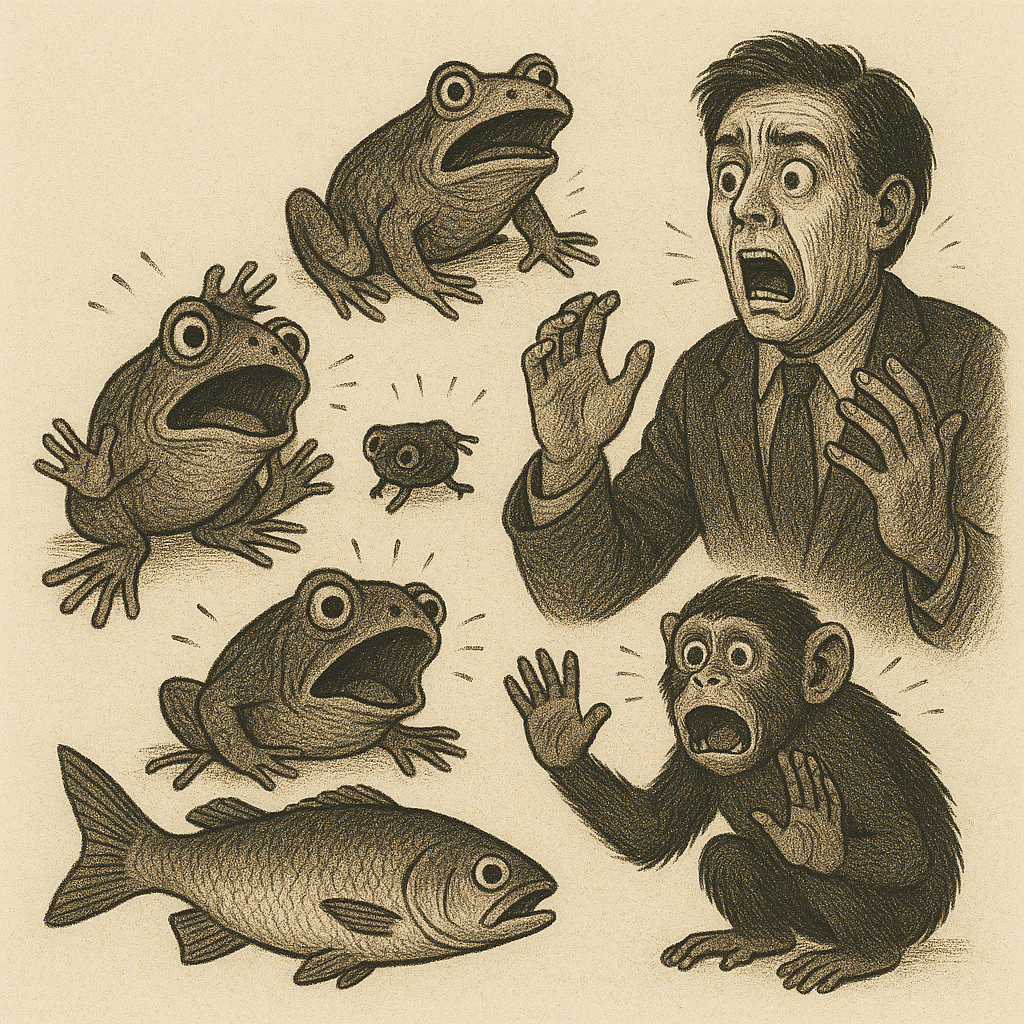
From lamprey Müller cells to teleost Mauthner neurons, from amphibian vestibulospinal tracts to mammalian PnC giant cells, the startle and defensive motor circuits reveal the continuity of the vertebrate nervous system. These brainstem modules are not inventions of higher brain evolution but conserved relics — ancient switches for halting behavior, freezing the body, and preparing for survival. Human clinical syndromes of startle exaggeration, posturing, and frontal release are best understood not as aberrations, but as disinhibitions of ancestral circuitry that has never left our nervous system.
The lesson of these reflexes is that the oldest parts of our motor hierarchy remain embedded in our daily lives, surfacing most clearly when inhibition fails, and reminding us that in moments of sudden threat, our brains still act like fish.
References
- Andermann, F., & Andermann, E. (1986). Startle disorders of man: Hyperekplexia and related syndromes. Advances in Neurology, 43, 133–146.
- Brown, P., Rothwell, J. C., Thompson, P. D., Britton, T. C., Day, B. L., & Marsden, C. D. (1991). Projections from the brainstem to the human hand motor cortex. Brain, 114(1A), 197–214. https://doi.org/10.1093/brain/114.1.197
- Davis, M., Falls, W. A., Campeau, S., & Kim, M. (1992). Fear-potentiated startle: A neural and pharmacological analysis. Behavioural Brain Research, 58(1–2), 175–198. https://doi.org/10.1016/0166-4328(92)90093-V
- Delwaide, P. J., & Toulouse, P. (1985). Startle responses in normal man: Influence of age and sex. Electroencephalography and Clinical Neurophysiology, 61(6), 519–524. https://doi.org/10.1016/0013-4694(85)91019-9
- Fisher, C. M. (1988). Pathological grasp and groping. Canadian Journal of Neurological Sciences, 15(1), 62–69. https://doi.org/10.1017/S0317167100027590
- Harvey, R. J., Topf, M., Harvey, K., & Rees, M. I. (2008). The genetics of hyperekplexia: More than startle! Trends in Genetics, 24(9), 439–447. https://doi.org/10.1016/j.tig.2008.06.005
- Koch, M. (1999). The neurobiology of startle. Progress in Neurobiology, 59(2), 107–128. https://doi.org/10.1016/S0301-0082(98)00098-7
- Koch, M., & Schnitzler, H. U. (1997). The acoustic startle response in rats—Circuits mediating evocation, inhibition and potentiation. Behavioural Brain Research, 89(1–2), 35–49. https://doi.org/10.1016/S0166-4328(97)02296
- Lee, Y., Lopez, D. E., Meloni, E. G., & Davis, M. (1996). A primary acoustic startle pathway: Obligatory role of cochlear root neurons and the nucleus reticularis pontis caudalis. Journal of Neuroscience, 16(11), 3775–3789. https://doi.org/10.1523/JNEUROSCI.16-11-03775.1996
- Miller, B. L., & Cummings, J. L. (Eds.). (1999). The human frontal lobes: Functions and disorders. New York, NY: Guilford Press.
- Plum, F., & Posner, J. B. (2007). Diagnosis of stupor and coma (4th ed.). New York, NY: Oxford University Press.
- Rosenberg, N. L. (1986). Abnormal motor responses in coma. Archives of Neurology, 43(5), 471–474.
- https://doi.org/10.1001/archneur.1986.00520050073021
- Shibasaki, H., & Hallett, M. (2005). What is the Bereitschaftspotential? Clinical Neurophysiology, 116(5), 1053–1072. https://doi.org/10.1016/j.clinph.2004.12.006
- Tassinari, C. A., Rubboli, G., & Volpi, L. (2002). Startle-induced epileptic seizures. Epileptic Disorders, 4(1), 23–27.