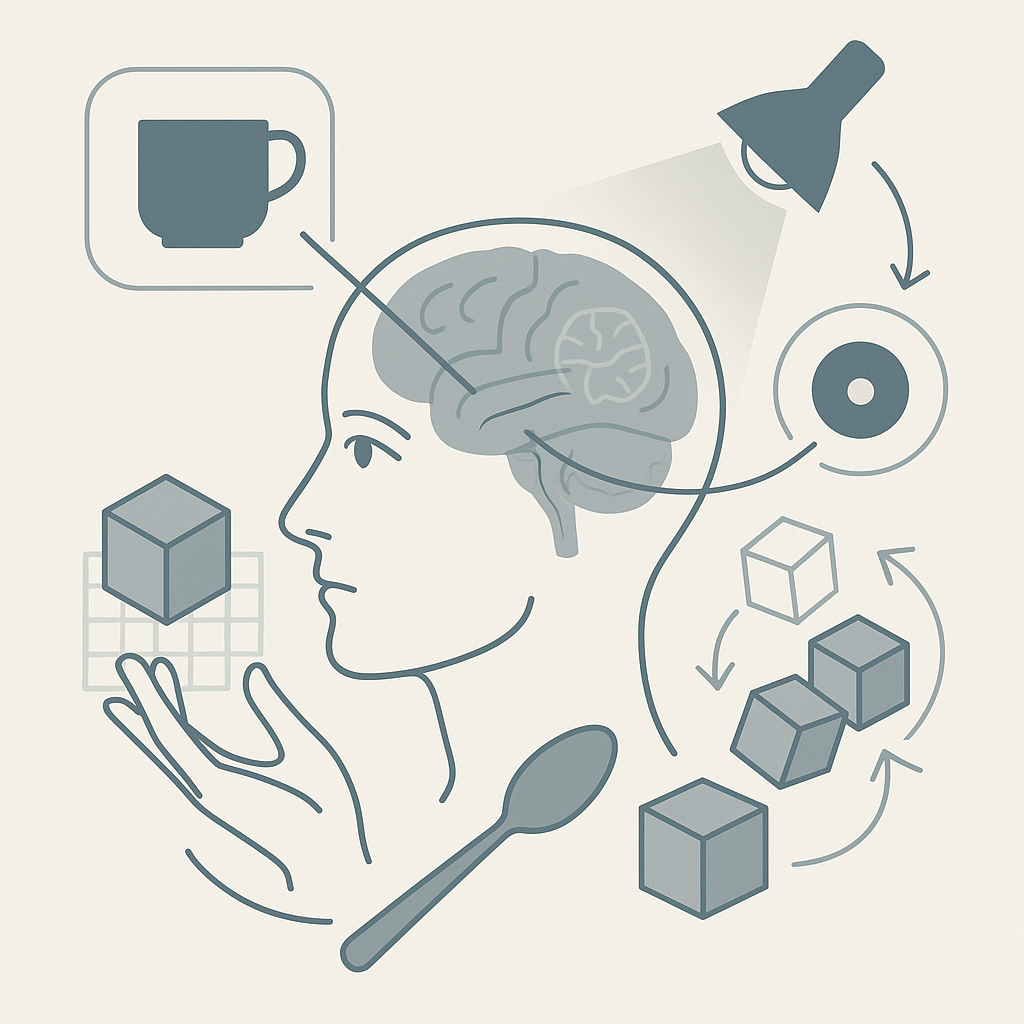
I. What Is Perceptual-Motor Dysfunction?
Perceptual-motor dysfunction refers to failure in the integration of sensory input with motor output-particularly where motor learning, sequencing, and action representation are disrupted. These impairments do not stem from weakness or sensory loss per se but from disordered cognitive translation between what is perceived and how one acts.
It spans:
- Apraxias: failure in learned motor tasks
- Agnosias: failure to recognize despite intact sensation
- Hemineglect: failure to attend or act toward one side of space
- Balint Syndrome: high-level breakdown of visual-motor coordination
This is not “just clumsinessâ€-it's higher-order breakdown in cognition-to-action pathways.
II. Neuroanatomical Foundations
- A. Unimodal Association Cortex
- Adjacent to primary sensory cortices
- Modality-specific (e.g., extrastriate cortex for visual processing)
- Damage → deficits in perception within a modality (e.g., visual agnosia)
- B. Heteromodal Association Cortex
- Posterior parietal region
- Integrates inputs across sensory domains
- Damage → loss of spatial awareness, action planning
- C. Basal Ganglia (Extrapyramidal System)
- Implicit motor learning
- Feedforward control
- Sequencing, coordination
- Dysfunctions → subtle, non-dopaminergic motor-planning deficits (e.g., in PD)
- D. Hemispheric Roles
Left hemisphere: “How†to perform a task (praxis)
Right hemisphere: “Where†in space to direct action (intention and attention)
III. Major Clinical Syndromes
1. Apraxia (Loss of Praxis)
Failure to perform overlearned, purposeful motor tasks despite preserved strength and comprehension.
| Type | Description | Localization |
|---|---|---|
| Ideomotor | Poor tool use/gesture imitation | Dominant parietal lobe, SMA, callosal |
| Ideational | Inability to sequence complex actions | Dominant posterior parietal |
| Conceptual | Loss of tool-use knowledge | Dominant posterior parietal |
| Limb-Kinetic | Loss of deft, skilled limb movements | SMA, primary motor cortex, basal ganglia |
| Orofacial (Buccofacial) | Can't move face/mouth on command | Inferior frontal, basal ganglia |
| Apraxia of Speech | Disrupted phoneme production | Broca area, SMA |
| Constructional | Can't copy/draw (visuoconstructive) | Either parietal lobe; exec planning (frontal) |
Clinical Insight: In bilateral ideomotor apraxia with preserved strength, suspect dominant parietal lesion or callosal disconnection.
2. Agnosia (Loss of Recognition)
Disconnection between perception and semantic knowledge.
| Type | Definition | Localization |
|---|---|---|
| Apperceptive | Impaired perception (can't draw/match) | Unimodal cortex |
| Associative | Can't assign meaning (can draw/match) | Disconnection to semantic areas |
Subtypes
Visual Agnosia: Can't ID objects
Prosopagnosia: Can't ID faces (often bilateral occipitotemporal)
Achromatopsia: Color awareness loss
Alexia: Word-form recognition deficit
Auditory Agnosia: Can't ID by sound
Astereognosia: Can't ID by touch
Agraphesthesia: Can't ID symbols traced on skin
Tip: Alexia without agraphia = dominant occipitotemporal disconnection to angular gyrus.
3. Hemispatial Neglect
Profound failure to acknowledge or act toward one side-typically left, from right parietal injury.
Multimodal (visual, tactile, auditory)
Anosognosia common and disabling
Frontal component: impairs intention, not just attention
Rule: Right hemisphere ≫ left for spatial awareness → right lesions cause neglect; left lesions rarely do.
4. Balint Syndrome
Breakdown of vision-action link, typically bilateral parietal-occipital damage.
| Feature | Description |
|---|---|
| Simultanagnosia | Can only see one object at a time |
| Optic Ataxia | Can't reach under visual guidance |
| Ocular Apraxia | Gaze initiation deficit; preserved spontaneous movement |
Clinical Clue: Patient describes scenes as “weird,†can read single letters but not words.
IV. Disease-Specific Considerations
Parkinson Disease
Impaired: implicit learning, sequencing, feedforward motor control
These do not improve with levodopa
Pathophysiology: basal ganglia circuit dysfunction
Cognitive-motor therapy may be needed.
Developmental Coordination Disorder (DCD)
Subtle motor deficits, especially in hand-eye tasks
Often co-occurs with ADHD and ASD
Issues with motor imagery in complex tasks
V. Rehabilitation Approaches
| Strategy | Target Condition | Notes |
|---|---|---|
| Right hemifield occlusion | Left neglect | Forces engagement of left visual space |
| Tai Chi | Age-related decline, PD | Improves hand-eye coordination |
| Video game training (e.g., Wii) | DCD, PD | Enhances reaction time, balance |
| Task-oriented therapy | DCD | Core strengthening + integration |
Key Takeaway: Rehabilitation must match the level of dysfunction (perceptual, motor, integrative) and be adaptive, multisensory, and engaging.
VI. Summary Takeaways
- Perceptual-motor dysfunction is a higher-order integration failure-not weakness, not sensory loss.
- It involves feedforward/feedback systems across parietal, frontal, and basal ganglia networks.
- Key disorders-apraxia, agnosia, hemineglect, Balint syndrome-offer windows into cortical and subcortical disconnection.
- Understanding the network-level logic of action, intention, and perception is critical to both diagnosis and recovery.
- Be alert to syndromes with normal strength and sensation, yet dramatic functional loss.