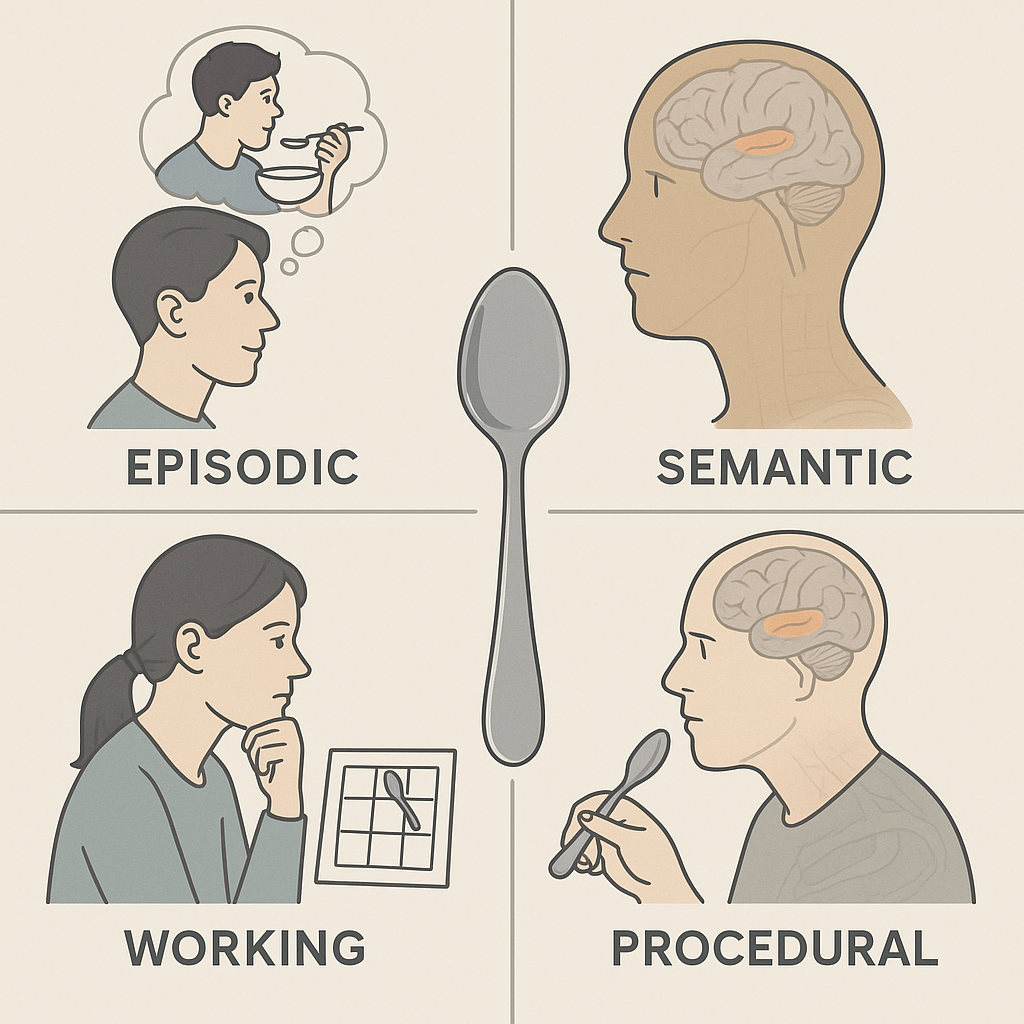
Human memory is not monolithic; it comprises multiple dissociable systems: episodic, semantic, working, and procedural memory.
These systems are supported by distinct yet interrelated neuroanatomical structures.These systems are crucial for processing information for future use and can be either conscious (explicit/declarative) or unconscious (implicit/nondeclarative). Memory dysfunction is a significant clinical concern, particularly with an aging population and increasing prevalence of neurodegenerative diseases. Early and accurate diagnosis of subtle memory dysfunction can facilitate predicting underlying neuropathology and accessing potential disease-modifying therapies.
The primary dissociable memory systems discussed are:
- Episodic Memory: Recalling personal experiences and episodes.
- Semantic Memory: Acquired knowledge about the world, facts, and concepts.
- Working Memory: Active maintenance and manipulation of information for goal-directed tasks.
- Procedural Memory: Learning and performing automatic skills.
I. Episodic Memory
- Definition: The ability to consciously recall personal experiences, including context of time and self.
- Core Processes:
- Encoding: Directing attention and initial processing.
- Consolidation: Stabilizing memory for long-term storage.
- Retrieval: Accessing stored information.
- Clinical Syndromes:
- Anterograde Amnesia: Failure to form new memories.
- Retrograde Amnesia: Loss of previously stored memories.
- Neuroanatomy:
- Medial temporal lobe, particularly the hippocampus (CA1–CA3, dentate gyrus, subiculum).
- This was famously demonstrated by the case of Henry Molaison (H.M.), who, after bilateral medial temporal lobe resections, exhibited "profound anterograde amnesia... as well as a lesser degree of retrograde amnesia."
- Extrahippocampal structures: entorhinal, perirhinal, parahippocampal cortices.
- Papez circuit (mamillary bodies, anterior thalamus, fornices).
- Posterior cingulate, precuneus, frontal lobes (encoding/retrieval).
- Functionally connected to the hippocampus, early alterations in these areas are seen in patients at risk for Alzheimer disease.
- Lateralization: Left = verbal, Right = visual/spatial.
- Right hippocampus: Correlated with visual, maze-learning tasks and visual memory. The "right posterior hippocampal gray matter volume of London taxi drivers... increases with the number of years of taxi driving and greater navigational expertise."
- Medial temporal lobe, particularly the hippocampus (CA1–CA3, dentate gyrus, subiculum).
- Disorders: temporal profile of dysfunction aids in diagnosis and treatment.
- Acute: Concussion, PCA stroke.
- Subacute: Herpes encephalitis, Wernicke-Korsakoff.
- Transient: TGA, transient epileptic amnesia.
- Transient Global Amnesia (TGA): "Profound anterograde and limited retrograde episodic memory impairment that may last up to 24 hours," often associated with punctate diffusion-weighted MRI abnormalities in the CA1 region of the hippocampus.
- Transient Epileptic Amnesia: Usually less than 1 hour, recurs monthly, and may involve unusual loss of remote autobiographic memories.
- Chronic: Alzheimer's, Lewy body dementias, hippocampal sclerosis.
- Alzheimer disease: Anterograde amnesia is the most common presentation.
- Lewy body dementias (Dementia with Lewy Bodies, Parkinson disease dementia) and frontotemporal dementias: Less likely to present with early episodic memory impairment but can progress to include it.
- Hippocampal sclerosis of aging: Often clinically diagnosed as Alzheimer disease, associated with advancing age and cerebrovascular pathology, and patients tend to have "less significant functional impairment than patients with Alzheimer disease."
- Evaluation:
- Collateral historian.
- Cognitive tests: WMS-IV Logical Memory, CVLT-II, BVMT-R, Rey-Osterrieth Recall.
- Imaging: MRI showing medial temporal atrophy.
- Treatment:
- Cognitive rehabilitation.
- Cholinesterase inhibitors, memantine.
II. Semantic Memory
- Definition: Semantic memory refers to "an individual's acquired knowledge about things in the world, their relationships, and their uses, including facts and concepts as well as words and their meanings." It is explicit and declarative, but abstracted from experience, making it distinct from episodic memory.
- Clinical Features:
- Often presents clinically with anomia (difficulty naming things), particularly for low-frequency words.
- Patients may use semantic paraphasic substitutions or refer to supraordinate categories.
- Profound impairment leads to "loss of object knowledge," potentially endangering patients (e.g., misusing household items).
- Neuroanatomy:
- Networks supporting semantic memory are "widely distributed throughout the brain."
- "Anterior and inferolateral temporal lobe regions are implicated as the major sites of pathology in patients with relatively isolated semantic memory deficits."
- The anterior temporal lobe serves as an "amodal hub," linking modality-selective regions (e.g., for motion, sound, color).
- Lateralization:Left fusiform gyrus atrophy/reduced glucose metabolism: Associated with poorer performance on verbal semantic tasks (e.g., picture naming).
- Right fusiform gyrus pathology: Associated with greater deficits on nonverbal semantic tasks (e.g., conceptual matching).
- Lateralization:
- Left fusiform: verbal (e.g., picture naming).
- Right fusiform: nonverbal (e.g., conceptual matching).
- Disorders:
- Semantic variant PPA (svPPA): Fluent anomia, progressing to mutism.
- Alzheimer's disease: Overlapping but distinct decline trajectory.
- Post-temporal lobectomy.
- Evaluation:
- Collateral historian.
- Tests: Boston Naming Test, WAIS-IV Information, Famous Faces.
- Look for surface dyslexia.
- Imaging: Atrophy in anterior temporal poles.
- Treatment:
- Speech therapy with compensatory strategies.
- SSRIs for behavior, cholinesterase inhibitors in Alzheimer's.
III. Working Memory
- Definition: Active maintenance and manipulation of information for goal-directed behavior. Working memory is an "explicit, declarative memory subtype" that involves the "active maintenance of verbal and nonverbal information in the mind for potential manipulation to complete goal-directed tasks." It is generally considered a component of executive function and is "associated with frontal lobe function."
- Function: Subtype of declarative memory, tightly linked with executive function.
- Neuroanatomy:
- Prefrontal cortex, subcortical areas, parietal association cortex.
- Disorders:
- Vascular insults, FTD, Lewy body dementia, PD dementia, TBI.
- Evaluation:
- Digit span, mental arithmetic.
IV. Procedural Memory
- Definition: Implicit ability to acquire and execute automated skills. Procedural memory is "nondeclarative, often implicit," and defined as "the ability to acquire (with practice) cognitive and behavioral skills that subsequently operate automatically." Examples include learning to drive a manual car or play a musical instrument.
- Examples: Playing an instrument, using tools, driving.
- Neuroanatomy:
- Evidence implicates the basal ganglia, cerebellum, and supplementary motor area of the cortex as critical for learning new procedures and habit formation.
- Disorders:
- Parkinson disease: Most common.
- Huntington disease, cerebellar degeneration.
- Evaluation:
- Not routinely tested; requires observation or individualized tasks.
- Imaging: May identify basal ganglia or cerebellar pathology.
- Treatment:
- Standard motor treatments may not restore procedural learning.
- Explicit retraining may leverage intact episodic/semantic systems.
Diagnostic & Therapeutic Considerations
- Collateral History: Crucial across all domains.
- Cognitive Testing: Tailored to memory subtype.
- Neuroimaging: Structural MRI and functional imaging.
- Pharmacologic:
- Cholinesterase inhibitors (e.g., donepezil) and memantine.
- SSRIs for behavioral variants.
- Rehabilitation: Especially helpful in early/mild stages.
- Compensatory Strategies: Inter-system engagement for compensation (e.g., explicit learning in procedural memory loss).
Suggested Reading Tools and Tests
- WMS-IV, CVLT-II, BVMT-R
- Boston Naming Test
- WAIS-IV Information Subtest
- Rey-Osterrieth Complex Figure
- Digit Span, Spatial Span
- Famous Faces (Northwestern)
Conclusion
Diverse neurological disorders can cause memory deficits, with neurodegenerative diseases like Alzheimer disease, svPPA, and Parkinson disease serving as models for understanding and treating the "dissociable but interrelated systems of episodic, semantic, and procedural memory." Future research areas include prospective memory (remembering to remember) and imagining the future.